
SIZE GUIDE
Choosing the right size is one of the most important decisions you’ll face before starting to crochet any garment.
Here you’ll find a sizing guide where you’ll learn how to take your measurements, what information to look for in the pattern, what ease is, and how to work and adjust your gauge swatch.
You’ll also find standard measurement charts that I use as a reference when designing my patterns.
If you want to know everything to consider for a perfect fit, keep reading…
TABLE OF CONTENTS
Step 1. How to take your measurements
First, you need to know your measurements. If you’re not sure how to take them, don’t worry — here’s the right way to do it.
Ideally, have someone help you take your measurements. If that’s not possible, you can measure yourself, or alternatively measure a garment you already own — though this last option is less reliable, as it depends on how that garment fits you.
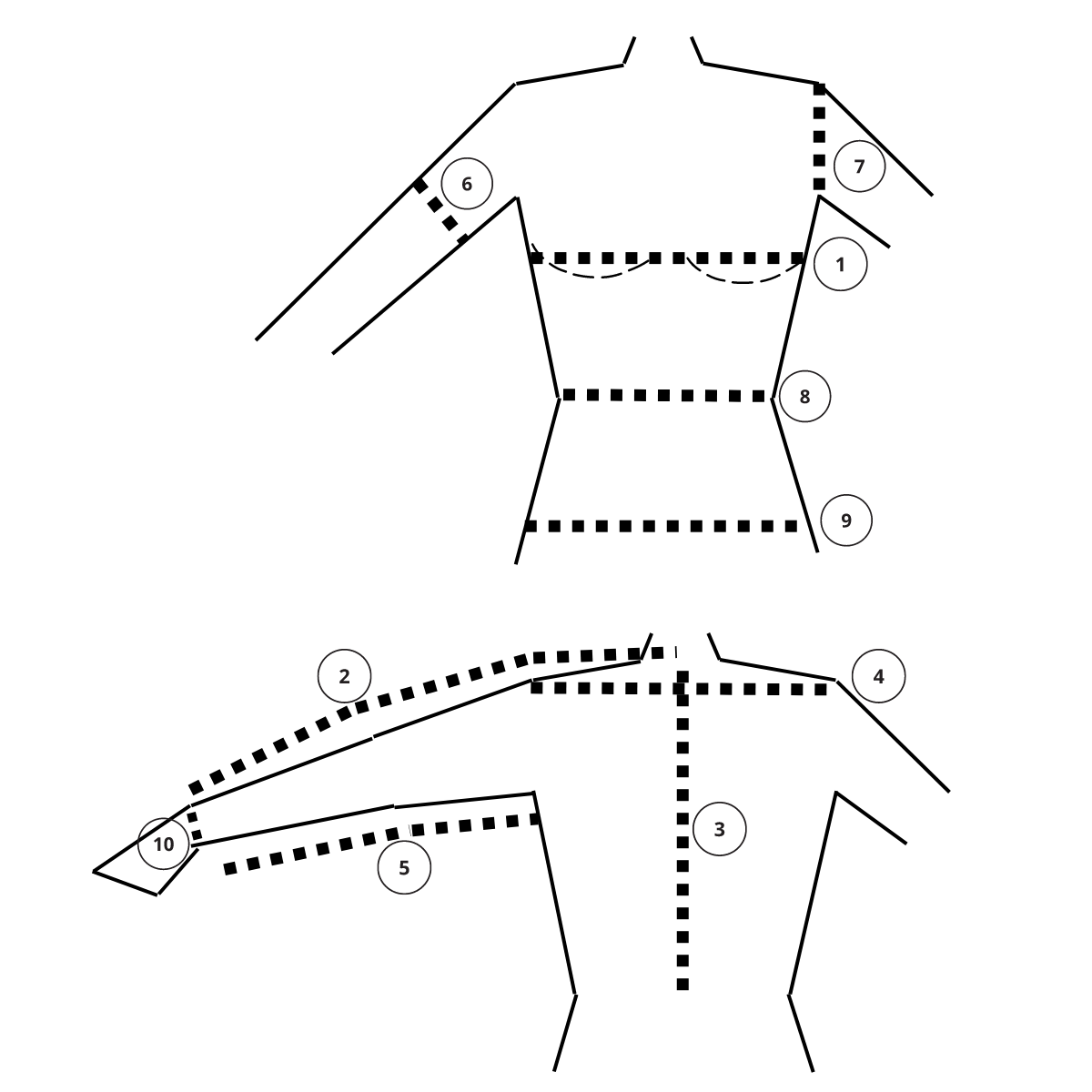
The charts below include 10 measurements, but some are more important than others. These are the ones to take first, as a minimum:
- 1. Bust / Chest
- 3. Back Waist Length
- 7. Armhole Depth
- 8. Waist
- 9. Hip
Once you know your measurements, compare them against the Standard Measurement charts below to find the size that suits you best.
How to take your measurements
- 1. Bust / Chest. Measure around the fullest part of your bust/chest without pulling the tape too tight.
- 2. Center Back Neck–to–Wrist. With your arm extended, measure along the back from the base of the neck, across the shoulder and down the arm to the wrist.
- 3. Back Waist Length. Measure from the most prominent bone at the base of the neck to the waist.
- 4. Cross Back. Measure from shoulder to shoulder.
- 5. Sleeve Length. With your arm slightly bent, measure from the armpit to the wrist.
- 6. Upper Arm Circumference. Measure around the widest part of the upper arm, above the elbow.
- 7. Armhole Depth. Measure from the outer edge of the shoulder down to the armpit.
- 8. Waist. Measure around the smallest part of your natural waist, generally just above the navel.
- 9. Hip. Measure around the fullest part of the lower hip.
- 10. Wrist Circumference. Measure around the widest part of the wrist.
Step 2. Standard measurement charts
Compare your measurements with the charts below to find the size that fits you best.
All crochet garment patterns are designed using standard body measurements as a reference. For my patterns, I follow the guidelines established by Craft Yarn Council.
Click on each tab to view the size charts for women, men, children, or babies.
Women’s standard measurement chart
| SIZE (cm) | XS | S | M | L | XL |
|---|---|---|---|---|---|
| 1. Bust / Chest | 75 | 85 | 95 | 105 | 115 |
| 2. Center Back Neck–to–Wrist | 67 | 69 | 72 | 74 | 74 |
| 3. Back Waist Length | 42 | 43 | 44 | 44 | 45 |
| 4. Cross Back | 36 | 38 | 40 | 42 | 44 |
| 5. Sleeve Length | 42 | 43 | 43 | 44 | 44 |
| 6. Upper Arm Circumference | 25 | 26 | 28 | 30 | 34 |
| 7. Armhole Depth | 16 | 17 | 18 | 20 | 21 |
| 8. Waist | 60 | 65 | 75 | 85 | 95 |
| 9. Hip | 85 | 90 | 98 | 110 | 120 |
| 10. Wrist Circumference | 18 | 18 | 18 | 19 | 19 |
| SIZE (cm) | 2XL | 3XL | 4XL | 5XL |
|---|---|---|---|---|
| 1. Bust / Chest | 125 | 135 | 145 | 155 |
| 2. Center Back Neck–to–Wrist | 77 | 78 | 80 | 81 |
| 3. Back Waist Length | 46 | 46 | 47 | 47 |
| 4. Cross Back | 46 | 46 | 47 | 47 |
| 5. Sleeve Length | 46 | 46 | 47 | 47 |
| 6. Upper Arm Circumference | 39 | 43 | 47 | 49 |
| 7. Armhole Depth | 22 | 24 | 24 | 26 |
| 8. Waist | 105 | 115 | 120 | 125 |
| 9. Hip | 133 | 138 | 143 | 156 |
| 10. Wrist Circumference | 20 | 20 | 21 | 21 |
Men’s standard measurement chart
| SIZE (cm) | S | M | L | XL |
|---|---|---|---|---|
| 1. Bust / Chest | 90 | 100 | 110 | 120 |
| 2. Center Back Neck–to–Wrist | 82 | 84 | 86 | 90 |
| 3. Back Waist Length | 60 | 64 | 68 | 72 |
| 4. Cross Back | 40 | 42 | 44 | 46 |
| 5. Sleeve Length | 46 | 47 | 49 | 50 |
| 6. Upper Arm Circumference | 30 | 34 | 38 | 39 |
| 7. Armhole Depth | 22 | 24 | 25 | 26 |
| 8. Waist | 75 | 85 | 95 | 110 |
| 9. Hip | 92 | 102 | 112 | 122 |
| 10. Wrist Circumference | 20 | 20 | 20 | 21 |
| SIZE (cm) | 2XL | 3XL | 4XL | 5XL |
|---|---|---|---|---|
| 1. Bust / Chest | 130 | 140 | 150 | 160 |
| 2. Center Back Neck–to–Wrist | 92 | 94 | 97 | 99 |
| 3. Back Waist Length | 74 | 76 | 76 | 79 |
| 4. Cross Back | 50 | 50 | 54 | 56 |
| 5. Sleeve Length | 52 | 52 | 54 | 54 |
| 6. Upper Arm Circumference | 42 | 44 | 47 | 48 |
| 7. Armhole Depth | 28 | 29 | 30 | 32 |
| 8. Waist | 120 | 130 | 140 | 150 |
| 9. Hip | 132 | 142 | 146 | 148 |
| 10. Wrist Circumference | 21 | 21 | 23 | 23 |
Children’s standard measurement chart
| SIZE (cm) | 2 | 4 | 6 | 8 |
|---|---|---|---|---|
| 1. Bust / Chest | 53 | 58 | 63 | 67 |
| 2. Center Back Neck–to–Wrist | 45 | 49 | 52 | 56 |
| 3. Back Waist Length | 22 | 24 | 26 | 31 |
| 4. Cross Back | 23 | 25 | 26 | 27 |
| 5. Sleeve Length | 21 | 26 | 29 | 31 |
| 6. Upper Arm Circumference | 17 | 19 | 20 | 21 |
| 7. Armhole Depth | 10 | 12 | 13 | 14 |
| 8. Waist | 54 | 54 | 57 | 59 |
| 9. Hip | 56 | 60 | 63 | 71 |
| 10. Wrist Circumference | 13 | 13 | 15 | 16 |
| SIZE (cm) | 10 | 12 | 14 | 16 |
|---|---|---|---|---|
| 1. Bust / Chest | 71 | 76 | 80 | 82 |
| 2. Center Back Neck–to–Wrist | 61 | 66 | 68 | 71 |
| 3. Back Waist Length | 35 | 38 | 40 | 42 |
| 4. Cross Back | 28 | 30 | 31 | 33 |
| 5. Sleeve Length | 34 | 38 | 40 | 42 |
| 6. Upper Arm Circumference | 22 | 23 | 24 | 24 |
| 7. Armhole Depth | 15 | 16 | 17 | 19 |
| 8. Waist | 62 | 63 | 67 | 69 |
| 9. Hip | 75 | 80 | 84 | 90 |
| 10. Wrist Circumference | 18 | 18 | 20 | 20 |
Baby standard measurement chart
| SIZE (cm) | 3m | 6m | 12m | 18m | 24m |
|---|---|---|---|---|---|
| 1. Bust / Chest | 40 | 43 | 45 | 48 | 50 |
| 2. Center Back Neck–to–Wrist | 27 | 29 | 31 | 35 | 45 |
| 3. Back Waist Length | 15 | 17 | 19 | 20 | 21 |
| 4. Cross Back | 18 | 19 | 21 | 22 | 22 |
| 5. Sleeve Length | 16 | 17 | 19 | 20 | 21 |
| 6. Upper Arm Circumference | 14 | 15 | 16 | 17 | 19 |
| 7. Armhole Depth | 8 | 9 | 10 | 10 | 11 |
| 8. Waist | 46 | 48 | 50 | 52 | 54 |
| 9. Hip | 48 | 50 | 50 | 54 | 56 |
| 10. Wrist Circumference | 10 | 11 | 12 | 13 | 14 |
Step 3. Read the pattern information
Most crochet patterns include the following information: the sizes available and a chart or schematic showing the finished measurements for each size.
These finished measurements may (and often do) differ from the standard body measurements — that’s because of ease.
The finished width of a garment is determined by your body measurement + ease
There are 5 types of ease:
To make sure you’re working the right size, it’s essential to read all the information provided in the pattern. By looking at the finished measurements and ease, you’ll know exactly how the garment will fit and can decide which size to make.
It’s common to be undecided between sizes — the only thing that will help is taking the time to check your measurements carefully.
That’s why I think you’ll find this guide useful.
Step 4. Always work your gauge swatch
Never skip your gauge swatch — this size guide means nothing if your gauge doesn’t match the designer’s. Those finished measurements are based on a specific hook size, yarn weight, and gauge.
If your gauge is off, the finished measurements will be too.
Step 5. Choose your pattern
Now you know your size, choose your next pattern:
